By Hossein Tanouri, Co-founder · Leads WorkRedesign Lab
“Let’s add AI to our workflow” sounds like a plan, but it is really a starting point. A workflow is not one thing. It is a chain of tasks, handoffs and decisions, and each of them deserves its own answer. Some tasks should disappear. Some should become simpler. Some can be handed to AI with a person reviewing the result. And some should stay firmly human.
In WorkRedesign Lab, we make that answer explicit, one task at a time, using eight decisions.
The eight decisions
- Eliminate: the task no longer needs to exist.
- Simplify: the task stays, with fewer steps or approvals.
- Standardize: everyone does it the same way, with a shared template or rule.
- Delegate: it moves to the role best placed to do it.
- AI-augment: AI drafts or analyzes, and a person reviews and decides.
- Automate: a routine, reversible, low-consequence task runs on its own, with logs and checks.
- Redesign: the way the work is done needs rethinking, not just a tweak.
- Keep human: the task depends on judgment, relationships or accountability, and stays with a person by design.
Notice that AI appears in only two of the eight. That is deliberate. This is a way to redesign work, not a way to choose software.
Following one workflow: client intake
Here is how the decisions play out in an illustrative client intake process, the kind many social service organizations run every day.
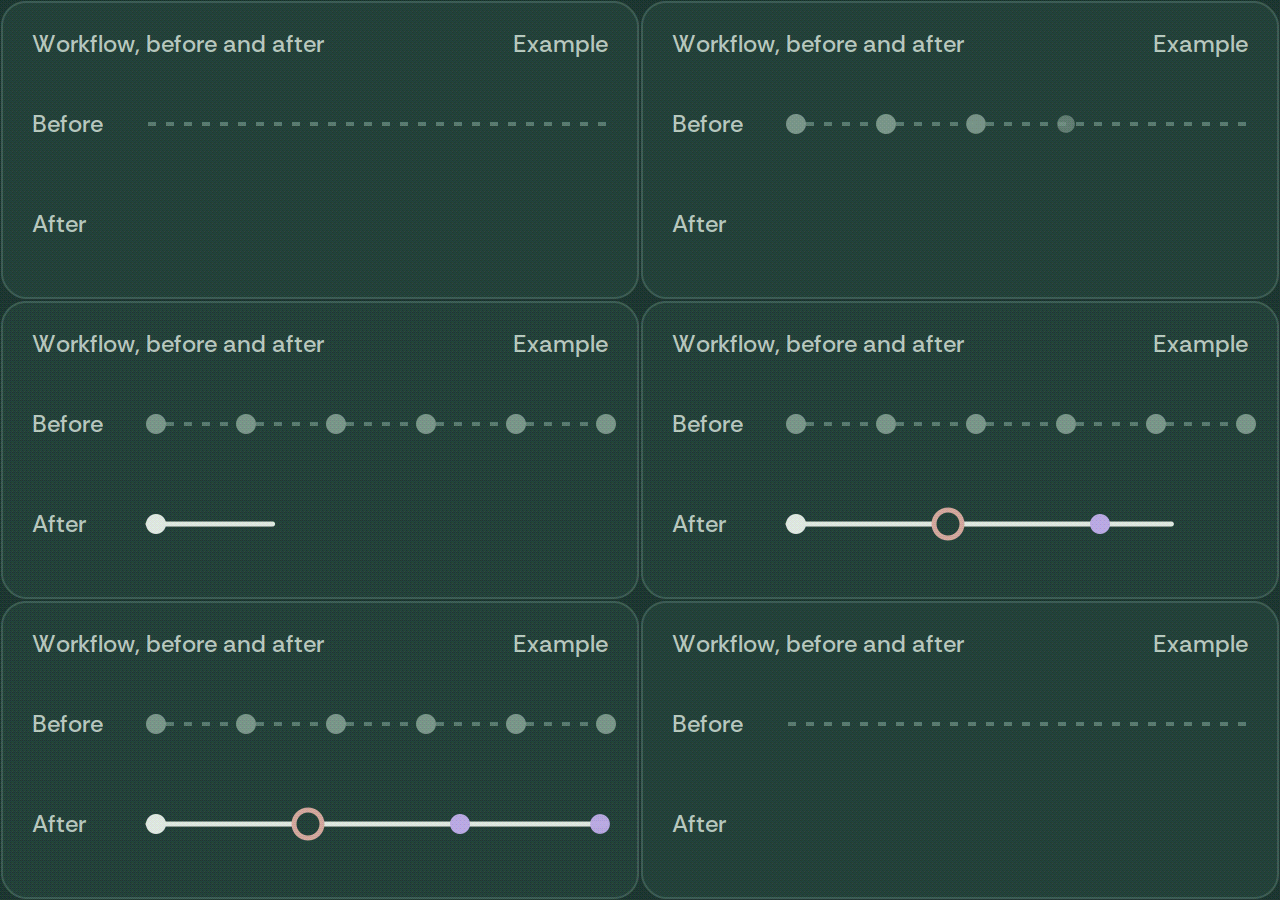
- Staff re-key each referral into a second database. Eliminate: the information already exists in the first one.
- Three people sign off before a file moves forward. Simplify: one approver, with a clear limit for when escalation is needed.
- Each caseworker writes intake notes in a different format. Standardize: one shared template.
- Checking documents against eligibility criteria takes hours. AI-augment: AI flags missing or mismatched information, and a caseworker reviews every flag.
- Deciding whether a family is eligible. Keep human: a trained caseworker decides, and the decision is recorded with its rationale.
- Appointment reminders are sent by hand. Automate: reminders go out automatically, and exceptions are flagged to a person.
The result is a shorter workflow with fewer handoffs, and a clear line around the step that matters most to the family on the other side.
What changes around the task
Redesigning tasks changes more than the tasks. When eligibility checks become AI-augmented, someone needs to own the review, know when to escalate, and have the skills to spot when the AI is wrong. When approvals are simplified, decision rights need to be written down. That is why each redesign also maps roles, responsibilities, decision rights and the capabilities people will need, so the new way of working holds up on a busy Monday, not just on paper.
Three common mistakes
- Automating a broken process. If a step should be eliminated, automating it only makes a waste of time faster.
- Forgetting the review work. AI-augmented tasks create new work: reviewing, correcting and escalating. Plan for it, or the time savings disappear.
- Redesigning without the people who do the work. The staff who run a process every day know where it really gets stuck. They belong in the room.
Where to begin
Choose one meaningful workflow with a committed sponsor. Map how it works today with the people who do it, including the handoffs, exceptions and workarounds that never appear in the official process. Then walk through it task by task and make the eight decisions together. You will be surprised how much changes before any technology is involved.
Have a workflow that feels harder than it should?
In a 20-minute call, we’ll look at it together and whether a three-week WorkRedesign Lab sprint is the right fit.

