By Hossein Tanouri, Co-founder · Leads Aati
Every week brings a new AI tool promising to save hours. For nonprofit and mission-driven leaders with stretched teams and tight budgets, the pressure to “do something with AI” is real. But the first question should not be which tool to buy. It should be: where is our work actually changing, and where would a change matter most?
Why tool-first decisions disappoint
When a tool comes first, it usually lands on a single task. That task may get faster, but the process around it stays the same: the same handoffs, the same approvals, the same unclear ownership. AI can even add work of its own, such as reviewing outputs, handling exceptions and fixing data problems. Teams end up with a pilot that looks promising in a demo and never scales, and staff who are understandably sceptical about the next one.
The problem is rarely the technology. It is that nobody first asked where the work was really changing, and why.
Start with the work, not the market
Workforce and AI transformation intelligence means looking at your organization the way the work actually happens: tasks, skills, roles, handoffs and capacity. It connects what is changing outside your organization, in technology, funding and demand, to what that means inside it. The goal is not a long report. It is a clear view of where to act first.
Five questions to find real opportunities
- Where does work wait? Queues, approvals and handoffs often cost more time than the tasks themselves.
- Where do skilled people spend time on low-judgment tasks? Re-keying data or formatting reports takes time away from the work only they can do.
- Where are errors or rework costly to the people you serve? Delays in intake or eligibility affect real families, not just spreadsheets.
- Where is demand growing faster than capacity? These are the places where doing nothing is also a decision.
- Where would a change be safe to test? Look for work that is reversible, low in consequence, and supported by data you can actually access.
Reading an opportunity map
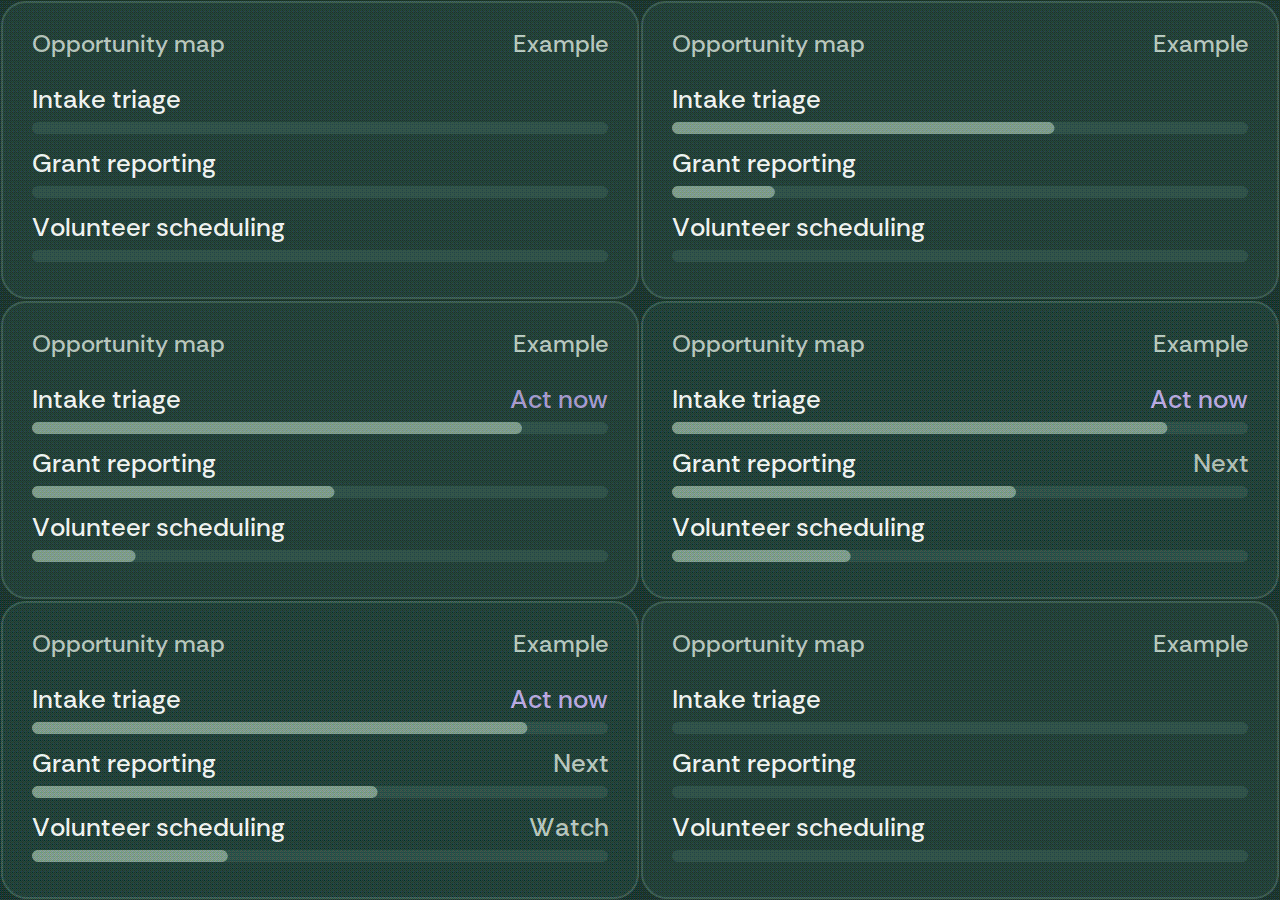
Answering those questions across your workflows produces an opportunity map. Each opportunity is weighed on four things: the value of changing it, how feasible the change is, the risks involved, and how ready the team and data are. The result is a simple ranking.
In the illustrative example above, intake triage is marked act now: it is slow, it affects clients directly, and the change is testable. Grant reporting comes next: valuable, but it depends on cleaner program data. Volunteer scheduling is one to watch: worth revisiting once the first changes are in place. A map like this turns a vague ambition into a sequence.
What changes for people
Every opportunity on the map has a workforce side. Some tasks move, some skills grow in importance, and some roles shift. Looking at this early matters: it lets you plan training, protect the judgment your clients rely on, and decide from the start who stays accountable when AI takes on part of the work. Productivity is one outcome among several. Quality, workload, service and mission outcomes matter too.
A decision, not a dashboard
The point of this work is a decision. A good assessment ends with a roadmap your leadership can act on: which opportunity to pursue first, what it will require in people, data and governance, and how you will know whether it worked. From there, the chosen workflow can be redesigned, and the change can be tested before anything scales.
Before you buy the next tool, map the work. The best AI investment is the one aimed at the right problem.
Not sure where your organization should start?
In a 20-minute call, we’ll talk through your work and whether an Aati assessment is the right first step.

